O kadar da dahiyane değil ama neyse… via Reddit. via Facebook Pages http://ift.tt/1heKubC
Filed under: Uncategorized Tagged: facebook
Related posts:
Vía Erkan’s Field Diary http://ift.tt/29bjZnZ
Illustrations by Blue Delliquanti and David Axe for The Intercept
One of the National Security Agency’s most powerful tools of mass surveillance makes tracking someone’s Internet usage as easy as entering an email address, and provides no built-in technology to prevent abuse. Today, The Intercept is publishing 48 top-secret and other classified documents about XKEYSCORE dated up to 2013, which shed new light on the breadth, depth and functionality of this critical spy system — one of the largest releases yet of documents provided by NSA whistleblower Edward Snowden.
A Look at the Inner Workings of NSA’s XKEYSCORE
How the NSA searches the world’s intercepted private communications
The class-action suit filed against Facebook in Vienna by Austrian law studentMax Schrems and his Europe Versus Facebook group has hit a roadblock.
The Wall Street Journal reported that a court in Vienna rejected the lawsuit on the grounds that it had no jurisdiction over the case.
Want to know where you friends and colleagues are? The all-new Map My Contacts app will help you quickly visualize the location of your Google contacts on a world map. It reads the postal addresses of people from your Google Contacts and puts them all in a Google Map using a simple Google script.
UPDATE 06/30/2015: The hearing has been postponed and will proceed in October. Thanks to everyone who helped us raise awareness today.
PARIS — French authorities took two Uber managers into custody for questioning on Monday over “illicit activity” involving its low-cost service.
Related posts:
Vía Erkan’s Field Diary http://ift.tt/1ersTjY
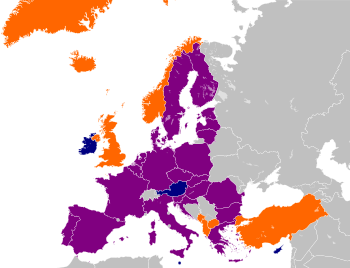
English: A map showing European membership of the EU and NATO. EU member only NATO member only Member of both Česky: Mapa zobrazující členství evropských států v EU a NATO. státy pouze v EU státy pouze v NATO státy v NATO a EU (Photo credit: Wikipedia)
Please find attached the final results of the MİPEX 2015 Survey (Integration Policies: Who Benefits? -MIPEX 2015) in which Bilgi’s European Institute and Kemerburgaz University have participed as partners from Turkey. These findings cover the immigration and integration policies in 38 countries and provide a ranking for each country including Turkey.
“Changes in government and far-right emergence: hard times for integration policies”
The MIPEX 2015 reveals a difficult context for integration in which things are changing very slowly
June 30, 2015
According to the new Integration Policies: Who Benefits? (MIPEX 2015), a project led by the Barcelona Centre for International Affairs (CIDOB) and the Migration Policy Group (MPG), several countries have lost positions due to restrictions and cuts: Greece on citizenship and voting rights, and the Netherlands and the United Kingdom on residence restrictions and targeted support cuts, both experiencing major drops in nearly all policy areas. With Sweden ranking 1st, Portugal continues to climb ahead on MIPEX despite the crisis and austerity, maintaining its investment in integration and working to increase its reach and effectiveness.
However, “political will may matter more than a country’s tradition of immigration, since more inclusive integration policies may both encourage more immigrants to settle permanently and the public to trust immigrants more” says Thomas Huddleston (MPG), co-director of the MIPEX 2015, who reminds us that integration policies differ significantly between Germany and Austria, Denmark and Sweden, or Portugal and Spain.
A demanding agenda at a time of major government changes and far-right emergence
According to the increasing number of EU residents, immigration should be a top item on the EU agenda, a demand that comes at a time of major government changes and close elections in several major destinations (between 2010 and 2014 in Australia, Belgium, France, Greece, Italy, Portugal, Spain, the United Kingdom and the Nordics).
In this context, far-right parties have never done better in recent European history, threatened mainstream parties and even entered into government positions, while public opinion on immigration is divergent across the EU and generally uninformed. This trend is reflected through a drop in the MIPEX score in those countries experiencing a rise in anti-immigrant attitudes and the success of far-right parties.
In this sense, Elena Sánchez-Montijano (CIDOB), co-director of the MIPEX 2015, emphasises the strong link between integration policies and public opinion, as they help the public to trust migrants and see benefits, while restrictive policies harden distrust and perceptions of threat.
In this particularly sensitive time for migration issues, the fourth edition of the MIPEX has focused on what governments are actually doing to promote the integration of migrants and whether their policies are effective in practice and who is benefiting from them. These are the main key findings on integration policies and their beneficiaries:
Within the EU, national policies are stronger in areas covered by EU law and weaker in areas of national policy
At a European level, the greatest areas of strength are that migrant workers, reunited families and permanent residents enjoy basic security, rights and protection from discrimination. On the other hand, the greatest obstacles are for foreign citizens to become citizens or politically active and for mainstream services to guarantee equal access and opportunities for immigrants (targeted employment, education and health support).
“Migration has become a highly contentious topic in Europe, with debates often grounded more in perceptions than in facts. The data published by MIPEX are very useful for all those who want to approach migration from a factual standpoint, and show that the integration of migrants is not only possible, but also beneficial for our society. This is recommended reading for all policy and decision makers.” Nils Muižnieks, Commissioner for Human Rights of the Council of Europe and former Latvian Minister responsible for Integration
“MIPEX 2015 delivers facts and inspiration from worst and best practice integration policies in EU member states and abroad. Moreover, MIPEX shows that immigrants in most of the countries are in danger to stay in legally precarious and socially excluded circumstances, being treated like second-class citizens in national politics and in daily life”. Ulrike Lunacek, Vice-President and Member of the European Parliament, The Greens/EFA, Austria
“I believe that diversity is a huge asset to our continent, economically, socially and culturally. Immigration has helped to change our economy boosting productivity and supporting growth. Europe’s strength as a multicultural centre was driven by the acknowledgement that our continent was open to new ideas, to new people and to new products.” Cécile Kashetu Kyenge, Member of the European Parliament, Group of the Progressive Alliance of Socialists and Democrats and former Italian Ministerresponsible for Integration
No related posts.
Vía Erkan’s Field Diary http://ift.tt/1JEsbNP
